Department
of Mathematics, WUSTL -
Math Club, Fall 2007
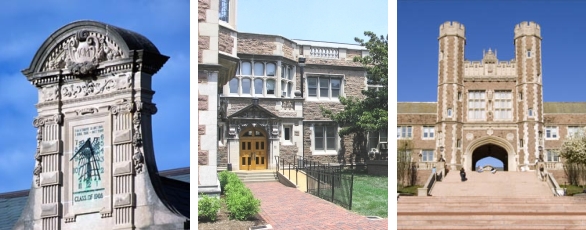
Washington University in St. Louis, Cupples I Hall, One Brookings Drive, St. Louis MO. 63130
Except for the movie on Sep 17th, all meetings will be in the Undergraduate Math Lounge, Room 222 in Cupples I.
Talks will run from 5:15 to 6:00, and will be followed by free pizza.
Sep 17th:
Movie; “The Proof”
Movie about Andrew Wiles’s proof of Fermat’s last theorem. In 199, Cupples I, at 5.10 p.m.
Sep 24th:
Gary Jensen; “Quaternions and Rotations in Space”
Abstract: I'll describe the basic properties of quaternions, and then show how any quaternion of unit length defines a rotation in ordinary space. Rotation in space is rotation about some axis. What then is the axis of the composition of two arbitrary rotations? Quaternions give an immediate solution to this problem. They also show that rotation through 360 degrees is distinguishable from rotation through 720 degrees. The talk will conclude with a physical demonstration of this strange claim.
Oct 1st:
John McCarthy; “Fibonacci Numbers: What does the golden ratio have to do with the spacing of sunflower seeds?”
Abstract: It is frequently observed that the florets in daisies or sunflowers spiral out with a number of spirals that is in the Fibonacci sequence (1,2,3,5,8,13,21,34,…). Why do these numbers crop up?
Oct 8th:
Andy Womack; "A gentle introduction to Bayesian Statistics"
Abstract: I will present the basic theory in Bayesian Statistics and do a couple of simple examples. Bayes's Theorem allows one to "invert" conditional probabilities. This analysis is used to estimate parameters of random variables and in the analysis of small data sets.
Oct 15th:
No talk
Oct 22nd:
Geir-Arne Hjelle; “Complex Iteration”
Abstract: Normally, simple processes yields easily predictable results. We will study an example of a simple process - iteration of a polynomial - which gives results that are very hard to predict. We will work with complex polynomials and use a computer to visualize the process. This helps us generate striking images, including what is arguably the most famous set in mathematics, the Mandelbrot Set. No prior knowledge of complex numbers is necessary.
Oct 29th:
Brad Henry; “Mathematical Elegance in an Art Museum”
Abstract: Suppose the manager of a museum wants to make sure that at all times every point of the museum is watched by a guard. The guards arestationed at fixed posts, but they are able to turn around. How many guards are needed? We will see how a single clever idea can take thispossibly difficult problem and make it easy. We will also give an introduction to "mathematical induction," which will help us turn theclever idea into an elegant proof.
Nov 5th:
Renato Feres; “Probability Theory and Chemistry”
Abstract: In his undergraduate thesis, Alexander Muller (Wash. U. graduate, 2007) showed how a fundamental mathematical result connecting random motion and partial differential equations can be used to calculate the conversion rate of certain chemical reactions. I will describe Alex's work, explain a few nice ideas from probability theory, and if time allows I'll talk a little bit about the joys and sorrows of research collaboration between mathematicians and chemical engineers.
Nov 12th:
Brian Maurizi; “Cracking the enigma code”
Abstract: We will look at (a simple model of) the top-secret communication system used by Germany in WWII, called the "enigma machine." This machine would encrypt a message in a way that the Germans thought was unbreakable. However, by analyzing the encryption method in terms of permutations, we will find its weakness! A hint: good thing the Germans weren't thinking about Group Theory!
Nov 19th:
Nan Lin; "Introduction to resampling methods"
Abstract: Classical parametric statistical inference depend on theoretically distributional assumptions whose validity is often difficulty to test. Resampling methods relax such assumptions by repeatedly sampling within the original sample. These methods had gained great popularity since the 1980's as more powerful computers became available. In this talk, we will go through several resampling methods, such as jackknife and bootstrap, to illustrate their elegance in obtaining statistical inference with the help of computers.
Nov 26th:
Al Baernstein ; "You might go home again: recurrence and transience of symmetric random walks in the first three dimensions"
Abstract: Suppose you start at the origin of the real line, toss a fair coin, then move one step to the right or left according as the coin falls heads or tails. Repeat the process, starting from your new position, then repeat again and again, ad infinitum. This process has evident analogues in all dimensions. What is the probability that you will ever return to your starting point? In particular, will you return with probability 1, or is there a positive probability you will never return? We’ll see that the answer depends upon the dimension of the world you live in.
March 24th: Blake Thornton; “The mathematics of Craps”