Math 4501 and 5051
Numerical Applied Mathematics
Fall, 2026
Professor Wickerhauser
|
|
NEWS:
|
QUICK LINKS:
- Chapter 8 exercises from the
4th Edition. Be careful, they are out of order, first 8.2, then
8.3, then 8.1.
- Octave is a freeware
imitation of current MatLab. It does not have
the symbolic algebra functions of commercial MatLab.
- Download Macsyma
to help you with your symbolic calculations.
- Here is NumericalMethods7.1.zip, a
compressed archive of the MatLab codes referenced in the text.
- Article
on differentiation without taking differences.
- Here is a nice 3-page online
proof that Gaussian quadrature abscissas and weights are,
respectively, roots and integrals of orthogonal polynomials.
- Some examples of cubic spline interpolation (courtesy of Prof. Sawyer):
- Some examples of Fourier series approximation (courtesy of Prof. Sawyer):
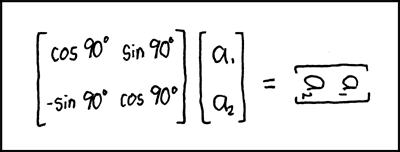
- One depiction of a rotation
matrix from xkcd.com.
|
SAMPLE PROGRAMS:
- eg-iter.txt: evaluate 20 terms of a
two-term recurrence relation.
- xcosx.txt: solve x=cos(x)
by fixed-point iteration and plot the result.
- Corrected help with Matlab function handles in
Sec.2.1, algorithm 1, p.51.
- bin2dec.m and dec2bin.m: convert
between binary and decimal integer formats.
- eg-plot3.txt: plot the edges of a cube.
- syndiv.m: synthetic division Matlab function.
- macsyma.txt:
formulas for the first 21 Chebyshev polynomials, Macsyma usage example.
- splineplot.txt: plot
two cubic splines on 4 knots, Octave example.
- parametric.txt: plot
a parametric Bezier curve, Macsyma example.
- parametric.txt: plot
a Bezier curve on 4 control points, Octave example.
- eulerdemo.m: Euler's method, Octave function.
- ceuler.m: centered Euler ODE solver
instability demo, Octave example.
- Function "nelder.m" as implemented in the textbook's software web site
is buggy. Download a fixed nelder.m and use it
instead. [Search for "CORRECTED" to find the two mistakes.]
|
Syllabus
Topics. Computer arithmetic, error propagation, condition number
and stability; mathematical modeling, approximation and convergence; roots of
functions; calculus of finite differences; implicit and explicit methods for
initial and boundary value problems; numerical integration; numerical
solution of linear systems, matrix equations, and eigensystems; Fourier
transforms; optimization. Various software packages are introduced and used.
Prerequisites. Math 2500 (formerly 217) Differential
Equations, Math 3300 (formerly 309) Matrix Algebra, and CSE 131 or
200 (or other programming experience with permission of the instructor).
These apply to both 4501 and 5051.
Time. Classes meet in person on Mondays, Wednesdays, and Fridays, 2:00 pm to 2:50 pm,
in Simon Hall, room 23.
Text. The lectures will follow John
H. Matthews and Kurtis D. Fink, Numerical Methods Using MATLAB,
fourth edition, ISBN 0-13-065248-2,
Pearson, 2004. Note: except for Chapters 5 and 8, the fourth edition
is virtually identical to the third edition.
Homework. You are encouraged to collaborate on homework, and
to work additional exercises from the indicated problem sections,
although the homework grade will be based only on the exercises listed
below. Please submit your solutions using GradeScope. Problem
sets will be assigned as follows:
- HW #1, due Fri, Sep 4
(Solutions)
- HW #2, due Fri, Sep 11
(Solutions)
(Graphs)
- HW #3, due Fri, Sep 18
(Solutions)
(Graphs)
- HW #4, due Fri, Sep 25
- HW #5, due Fri, Oct 2
- HW #6, due Fri, Oct 9
|
|
- HW #7, due Fri, Oct 23
- HW #8, due Fri, Oct 30
- HW #9, due Fri, Nov 6
- HW #10, due Fri, Nov 13
- HW #11, due Fri, Nov 20
- HW #12, due Fri, Dec 4
|
|
The lowest HW will not be counted, and the homework score will
instead be the average of the top 11 HW percentages.
Solutions must be completed by 11 pm on the due date. Late
homework will not be accepted. The problems will often
require a complete proof. The homework will be judged for correctness
and clarity. When the problem requires a computed solution, it must
be accompanied by a correct, well-documented computer program which
will be judged for its understandability. Please submit:
(i) the program, with a comment for every line, (ii) the input you
gave it, and (iii) the output it produced, for at least one example
run.
Tests. There will be one midterm examination in class on
Friday, Oct. 16, 2026.
There will be one cumulative
take-home final examination emphasizing the
remaining material, due on Monday, December 14th, 2026 by
11PM. It will be presented on GradeScope.
Grading. One score will be assigned for homework, one for the
midterm examination, and one for the final examination. These three will
contribute in respective shares of HW 40%, MT 30%, and FE 30% to the course
score. Letter grades, computed from the course score class average and
standard deviation, will be at least the following:
| Course score at least: | 90% | 80% | 70% | 60% |
|---|
Letter grade at least: | A | B | C | D |
Students taking the Cr/NCr or P/F options will need a
grade of D or better to pass.
Students auditing will be required to attend at least 37 of the
scheduled 41 lectures. Please identify yourself to the instructor at
the first class meeting.
Graduate Student Requirements
Students enrolled in the graduate-level version of this course are
expected to complete work at a level above that required of undergraduate
students, to reflect the greater depth, independence, and
level of mathematical maturity expected of graduate students.
In particular, letter grades will be the following:
| Course score at least: | 93% | 85% | 77% | 70% |
|---|
Letter grade at least: | A | B | C | D |
Graduate students taking the Cr/NCr or P/F options will need a
grade of C or better to pass.
Computing. Students are encouraged to use Octave (or MATLAB)
and Macsyma (or wxMaxima) for both symbolic and numerical
computations. These may be obtained by following these URLs:
Office Hours. MWF 3:00-4:30pm, in my
office in Cupples I, room 105a, or by
appointment.
Questions? Return to
M. Victor Wickerhauser's home page for contact information.