Plenary Speakers

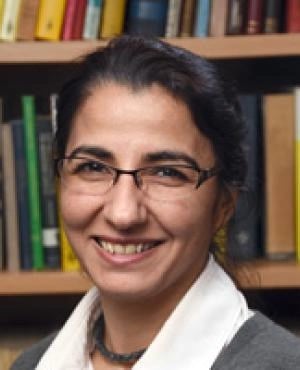
Marianna Csörnyei

Department of Mathematics
University of Chicago
https://mathematics.uchicago.edu/people/profile/marianna-csoernyei/

Complexity methods in geometric measure theory, Part 1.
We will introduce the computability-theoretic concept of Kolmogorov complexity and demonstrate how it can be used to obtain exciting results in geometric measure theory. The presentation will not assume any prior knowledge of computability theory.

Alex Iosevich

Department of Mathematics
University of Rochester
https://www.sas.rochester.edu/mth/people/faculty/iosevich-alex/index.html

On spectral complexity in harmonic analysis.
We are going to show that in a wide variety of settings, the Fourier ratio $\frac{\|\hat{f}\|_1}{\|\hat{f}\|_2}$ is the key controlling parameter for problems ranging from the uncertainty principle, sampling, and imputation of time series, to spectral synthesis and uniqueness of PDE solutions, spectral theory of graphs, and metric entropy. We are going to describe a series of results, on the surface very different from one another, united by the common theme of spectral complexity. Connections with Kolmogorov complexity and its variants, and learning theory will also be explored. This talk is based on joint papers with Will Burstein, Shantanu Deodhar, Vishal Gupta, Zhihe Li, Eyvi Palsson, Akshay Sant, and Alexia Yavicoli.

Azita Mayeli

Graduate Center
City University of New York
https://sites.google.com/view/azitamayeli/

Wave packet systems and connections to spectral analysis
of limiting operators.

We discuss the design of ``wave packet systems'' that admit strong concentration properties in spatio-frequency space. We make a connection between this problem and topics in signal processing related to the spectral behavior of spatial and frequency-limiting operators. The results have engineering applications in medical imaging, geophysics, and astronomy.

Yumeng Ou

Department of Mathematics
University of Pennsylvania
https://web.sas.upenn.edu/yumengou/

Pinned $k$-stars and application to Falconer type problems for graphs.
The Falconer type problems ask for the optimal dimensional threshold guaranteeing that any set whose Hausdorff dimension exceeding the threshold generates a large point configuration set. We will introduce some recent development on the problem when the point configuration is chosen to be the pinned k-star, i.e. the set $\{(|x_1-y|, \cdots, |x_k-y|):\, y\in E\}$, where $x_1, \cdots, x_k$ are some fixed points in $E$. We will also discuss how to apply such results to study the Falconer type problem for other graphs.

Alexia Yavicoli

Department of Mathematics
University of British Columbia
https://www.alexiayavicoli.org/

The Erdős Similarity Conjecture.
The Erdős similarity conjecture states that no infinite set of real numbers can be affinely embedded into every measurable set of positive Lebesgue measure. I will discuss two results: the first result (joint work with P. Shmerkin) shows that Cantor sets of ``positive logarithmic dimension'' satisfy the Erdős similarity conjecture, while the second result (joint work with A. Iosevich) shows that there also exists a family of extremely thin Cantor sets satisfying the conjecture.

Washington University in St. Louis – Danforth Campus

1 Brookings Drive, St. Louis, Missouri 63130

Contact: ssra48stlouis@gmail.com